Online First: 17 lipca 2026
https://doi.org/10.56583/fs.3069
nadesłano: 23 lutego 2026 | zaakceptowano: 1 lipca 2026
Licencja CC BY-NC-SA 4.0
ISSN: 1899-3109; eISSN: 2956-4085
EKONOMIA I FINANSE
ECONOMICS AND FINANCE
Dr. habil. Magdalena Kozera-Kowalska, Assoc. Prof.
Poznań University of Life Sciences
e-mail: magdalena.kozera@up.poznan.pl
https://orcid.org/0000-0002-9245-0548
Dr. Jarosław Uglis
Poznań University of Life Sciences
e-mail: jaroslaw.uglis@up.poznan.pl
https://orcid.org/0000-0001-6653-2745
Katarzyna Nawrocik
e-mail: katarzyna190501@gmail.com
https://orcid.org/0009-0001-4852-5055
Doświadczanie nierówności kobiet na rynku pracy w Polsce: społeczno-demograficzne uwarunkowania percepcji zjawiska
Summary
This article examines inequalities in the Polish labor market, with a particular focus on the gender perspective. Based on 203 surveys collected between July and October 2025 from individuals who follow job-search blogs, the study identifies how gender-based inequalities are perceived. It assesses perceptions of the legal protection afforded to women and men as employees, while determining the extent of unequal treatment of women. The findings indicate that perceptions of discrimination against women are significantly influenced by structural barriers to career development, advancement, and labor market entry or re-entry. Furthermore, cases of discrimination against women in the Polish labor market are significantly more frequent than those against men. Consequently, the perception of the scale of unequal treatment is strongly rooted in gendered experiences and perspectives, fitting into broader European patterns of gender inequality.
Keywords: labor market; experience of inequality; gender; unequal treatment factors; legal protection against discrimination
Streszczenie
W artykule podjęto rozważania nad nierównościami na rynku pracy w Polsce, ze szczególnym uwzględnieniem perspektywy płci. Celem badań przeprowadzonych na podstawie 203 ankiet zebranych w okresie lipiec–październik 2025 roku wśród osób śledzących blogi o tematyce poszukiwania pracy było rozpoznanie sposobu postrzegania nierówności ze względu na płeć. Podjęto próbę oceny postrzegania stanu ochrony prawnej kobiet i mężczyzn jako pracowników, a także określenia skali występowania problemu nierównego traktowania kobiet. Badanie wskazało, że: na postrzeganie zjawiska dyskryminacji kobiet istotny wpływ wywierały zwłaszcza strukturalne bariery rozwojowe i awansowe oraz bariery wejścia i powrotu na rynek pracy; przypadki dyskryminacji kobiet na rynku pracy w Polsce są znacznie częstsze niż mężczyzn; w warunkach polskich percepcja skali nierównego traktowania kobiet na rynku pracy jest silnie osadzona w doświadczeniach i perspektywie płciowej; subiektywne poczucie nierównego traktowania kobiet w Polsce wpisuje się w szersze europejskie wzorce nierówności płci na rynku pracy.
Słowa kluczowe: rynek pracy; doświadczenie nierówności; płeć; czynniki sprzyjające nierównemu traktowaniu; ochrona prawna wobec dyskryminacji
The labor market constitutes a dynamic process where complex interactions occur between individuals and institutions, shaping labor supply and demand while determining the conditions and prices of transactions. It is simultaneously a system influenced by numerous social, economic, and technological factors, resulting in a state of continuous transformation and the emergence of undesirable phenomena and behaviors. Polish law guarantees equality of employees in the labor market and prohibits employment discrimination based on characteristics such as gender, age, disability, race, or origin. These principles are regulated by the Labor Code, which mandates equal treatment in key areas of the employment relationship, including recruitment, employment conditions, promotion, professional training access, and termination. Nevertheless, deviations from these principles continue to occur, generating inequalities across various dimensions of the labor market. The literature most frequently addresses inequalities in employment and remuneration,1 while also drawing attention to violations of anti-discrimination provisions, infringements on equal access principles, and attempts to undermine equal treatment standards.2
Current structural transformations in the labor market give rise to new sources of inequality, resulting from processes such as automation and digitalization, labor shortages in certain countries (particularly European ones), and the consequent economic migration from third countries. These inequalities affect different groups of workers to varying degrees. Crucially, the perception of inequality in the labor market is highly subjective and depends on numerous factors, including prejudice, stereotypical thinking, and insufficient knowledge and awareness. It is further exacerbated by the persistence of rigid power structures, social hierarchies, and historical and cultural determinants. Additional influences include the lack of representation for specific group interests, media influence, the absence of anti-discrimination and equality policies at the organizational level, and environmental pressures.3
From a sociological perspective, perceptions of labor market inequalities are shaped not only by individual experiences but also by broader social structures, gender regimes, and cultural norms that influence how individuals interpret their position in society. As Sylvia Walby emphasizes, gender inequalities are embedded in institutional arrangements and social relations that contribute to the reproduction of unequal opportunities and outcomes.4 Similarly, Harriet Bradley argues that labor market inequalities are closely linked to socially constructed expectations regarding women’s and men’s social roles.5
Consequently, labor market inequality, particularly concerning gender, remains a relevant and compelling area of scientific inquiry. In light of rapidly changing socio-economic conditions, this line of research continues to retain its significance.
Inequality constitutes the opposite of equality and refers to the differential treatment of identical elements or the identical treatment of inherently different elements.6
In sociological analyses, inequality is understood more broadly than merely unequal economic outcomes. It also encompasses unequal access to resources, power, social prestige, and opportunities, which are often reproduced through social institutions and cultural norms.7
In practice, inequalities are often associated with discrimination, which is considered one of their forms.8 Discrimination denotes differentiation or unjust, typically less favorable treatment based on a personal characteristic that is not objectively justified.9 Inequality in employment refers to less favorable treatment of an individual compared to others in a similar situation due to characteristics such as gender, age, disability, religion, or contract type.10 Both discrimination and inequality (unequal treatment) are heterogeneous concepts that vary in intensity and form, ranging from subtle manifestations to overt or even aggressive expressions. Discriminatory attitudes may be expressed verbally, through actions, or through gestures.11 In certain cases, discrimination may also be generated and perpetuated through mass media and commonly held opinions.12 It may affect individuals as well as social groups and may involve economic entities, particular sectors, or entire economies. One of the principal areas where discrimination is observed is the labor market. Inequalities in this sphere encompass employment mechanisms, professional development, remuneration (including wage inequalities), working conditions, promotion opportunities, and disparities arising from unstable forms of employment depending on the occupational group or contract type.
Thus, discrimination is defined as the legally unjustified and objectively unwarranted differential treatment of employees in comparable situations. In extreme cases, it may even aim to exclude specific individuals from certain areas of social life.13 Contemporary manifestations increasingly include humiliation, degradation, and harassment .14
In Polish law, the concept of discrimination was clarified in connection with Poland’s accession to the European Union and the implementation of EU law.15 The Act specifies the areas and methods of counteracting violations of the principle of equal treatment on the grounds of gender, race, ethnic origin, nationality, religion, belief, worldview, disability, age, or sexual orientation.
Moreover, the Labor Code of Poland16 recognizes any form of discrimination in employment, direct or indirect, as inadmissible, particularly on the basis of gender, age, disability, race, religion, nationality, political beliefs, trade union membership, ethnic origin, creed, sexual orientation, fixed-term or indefinite employment status, and full-time or part-time employment (Art. 113). Furthermore, employees are entitled to equal rights for the equal performance of identical duties, with particular reference to the equal treatment of women and men in employment (Art. 112, Art. 183c).
On the other hand, the adoption of the Act on the Implementation of Certain Provisions of the European Union in the Field of Equal Treatment17 provided greater conceptual clarity regarding the legal definitions of inequality in the Polish labor market. It explicitly defined concepts such as indirect discrimination, harassment, sexual harassment, unequal treatment, and the principle of equal treatment. Indirect discrimination is defined as a situation in which, due to a seemingly neutral provision, criterion, or practice, a person is or could be placed at a particular disadvantage on the grounds of gender, race, ethnic origin, nationality, religion, belief, worldview, disability, age, or sexual orientation, unless the provision, criterion, or practice is objectively justified by a legitimate aim and the means of achieving that aim are appropriate and necessary. Harassment refers to any unwanted conduct whose purpose or effect is to violate a person’s dignity and create an intimidating, hostile, degrading, humiliating, or offensive environment. Sexual harassment is defined analogously, with the conduct being of a sexual nature or related to sex, potentially including physical, verbal, or non-verbal elements.
Unequal treatment is defined as behavior constituting direct or indirect discrimination, harassment, sexual harassment, less favorable treatment resulting from rejecting or submitting to harassment or sexual harassment, as well as encouraging or ordering such behavior. The principle of equal treatment is understood as the absence of any such behaviors.
As the labor market evolves, new manifestations of unequal treatment emerge. In response, Polish legislative initiatives have proposed an expansion of the concept of discrimination.18 The draft introduces, inter alia, associative discrimination (based on characteristics of a related person, e.g., a parent of a child with a disability) and discrimination by association (based on group membership). It further proposes recognizing any case of unequal treatment as discrimination, regardless of the specific protected ground, thereby broadening the scope of legal protection and available remedies.19
Despite the extensive legal framework safeguarding equal treatment in the labor market, the persistence of inequalities raises questions regarding their underlying causes. One potential source of inequality is the inadequate implementation of human resource policies,20 given that the design and execution of personnel policies, from recruitment to employment termination, reflect the value preferences of organizational decision-makers. Although cultural patterns and value systems evolve, they do so gradually. Stereotypes, as the initial link in the chain of discrimination, attribute negative characteristics to specific groups. For example, women may be stereotypically perceived as overly emotional, less competent, or less capable of self-organization, ultimately resulting in discriminatory practices.
Gender scholars point out that such stereotypes play a crucial role in maintaining occupational segregation and unequal career opportunities. Social expectations related to caregiving responsibilities, motherhood, and leadership continue to shape employers’ perceptions and employment decisions, often to the disadvantage of women.21
Such stereotypes may already operate at the point of labor market entry, where young women are frequently evaluated through the lens of potential motherhood and presumed long-term absences.
In addition, another significant issue related to labor market inequality is self-stigmatization, whereby members of groups exposed to inequality internalize harmful beliefs and lower their self-esteem.
This study aimed to identify how unequal treatment is perceived in the Polish labor market, including the impact of socio-demographic characteristics on respondents’ opinions. To achieve this objective, the following research questions were formulated:
Additionally, the study attempted to assess the state of legal protection afforded to women and men as employees and to estimate the scale of the problem of unequal treatment of women in the Polish labor market.
Based on the literature review and the adopted research assumptions, the following research hypotheses were formulated:
The empirical data were collected through a survey using a structured questionnaire administered to both female and male respondents. The survey was conducted between July and October 2025. A non-probability purposive sampling method using the snowball technique was employed. A link to the online survey, along with information about the purpose of the study, was shared on social media, and respondents were encouraged to forward the survey to their contacts. The questionnaire was distributed in two formats: computer-assisted web interviewing (CAWI) and paper-and-pencil interviewing (PAPI), enabling the collection of data from a broad group of respondents. The study was anonymous and voluntary and was conducted on a sample of 203 respondents. The research procedure was approved by the Rector’s Ethics Commission for Scientific Research Involving Human Participants at the Poznań University of Life Sciences (Application no. 11/2024).
A five-point Likert scale was employed in the questionnaire, with the midpoint indicating a neutral response (no clear opinion on the statement). The use of this scale made it possible to capture variation in respondents’ attitudes and increased the precision of measuring the intensity of evaluations.22
The collected data were subjected to statistical analysis using the Jamovi application and Statistica 13.3 software. Non-parametric statistical procedures were applied, including Pearson’s chi-square test of independence, factor analysis with varimax rotation, logistic regression, the Mann-Whitney U test, the Kruskal-Wallis test, and McNemar’s test. Results were considered statistically significant at p < 0.05. The results were presented in descriptive, tabular, and graphical form.
The survey was completed by a total of 203 respondents. The majority of participants (76.8%) were women. The respondents’ ages ranged from 18 to 62 years, with a mean age of 29.7 years (median = 25 years). The sample was dominated by individuals with higher education (62.1%), while the remaining respondents (37.9%) had secondary or lower educational attainment. Educational level was reflected in monthly net income per capita. The largest proportion of respondents (33.0%) reported a monthly net income in the range of PLN 4,501–6,500, followed by 30.5% in the PLN 2,501–4,500 range. The majority of respondents resided in large cities with more than 100,000 inhabitants (58.6%), whereas the proportions of those living in smaller towns (20.2%) and rural areas (21.2%) were comparable.
The first stage of the analysis addressed whether respondents perceived the phenomenon of unequal treatment of women in the labor market. A clear majority (72.9%) answered affirmatively, while 27.1% did not perceive such a phenomenon. The gender structure of respondents (Table 1) revealed a marked predominance of women (85.8%) among those declaring the existence of unequal treatment. Among respondents who did not perceive unequal treatment, the proportions of women and men were similar.
Source: Authors’ own work.Pearson’s chi-square (χ²) tests of independence were conducted to assess whether demographic variables were associated with the perception of unequal treatment of women. The analysis demonstrated that only the respondents’ gender was significantly associated with the perceived presence of unequal treatment (χ² = 24.67, p < 0.001), with a moderate effect size (Cramér’s V = 0.35). Women reported perceiving this phenomenon significantly more frequently than men. In contrast, no statistically significant relationships were found between perception of unequal treatment and the other demographic variables – age, educational level, place of residence, and monthly net income per capita (p > 0.05). The effect sizes measured by Cramér’s V were very small (0.01–0.18), indicating a lack of practically meaningful associations.
A key component of the study was identifying forms of unequal treatment of women in the labor market. The ten selected manifestations were analyzed (Table 2). Factor analysis was applied, yielding three factors describing the phenomenon: (1) structural barriers to professional development and promotion, (2) interpersonal discriminatory behaviors, and (3) barriers to labor market entry and re-entry.
The Kaiser-Meyer-Olkin (KMO) measure of sampling adequacy was 0.90, and Bartlett’s test of sphericity was statistically significant (p < 0.001), confirming the suitability of the data for factor analysis. The three extracted factors jointly explained 74.3% of the total variances. The corresponding Cronbach’s alpha coefficients were 0.85, 0.89, and 0.72, indicating acceptable to good internal consistency. As the methodological literature suggests, alpha values exceeding 0.70 are considered acceptable in reliability assessments.23
Source: Authors’ own work.To assess whether the intensity of the identified factors predicted the perception of unequal treatment of women, a logistic regression model was estimated (Table 3). The model demonstrated good fit (McFadden’s R² = 0.293; AIC = 174).
In the first stage of the analysis (initial model), significant predictors included structural barriers to professional development and promotion (OR = 0.33; 95% CI [0.19, 0.60]; p < 0.001) and barriers to labor market entry into and re-entry (OR = 0.55; 95% CI [0.35, 0.85]; p = 0.008). Crucially, an increase in the scores of both factors was associated with a higher likelihood of perceiving the unequal treatment of women. By contrast, interpersonal discriminatory behaviors did not constitute a significant predictor (p = 0.848).
Source: Authors’ own work.Accordingly, the logit model was simplified by excluding the non-significant predictor, resulting in a more parsimonious and better-fitted model. In the final model, both retained predictors remained statistically significant. An increase in the scores for structural barriers to development and promotion was associated with a higher likelihood of perceiving unequal treatment (OR = 0.32; 95% CI [0.19, 0.53]; p < 0.001), as was an increase in the scores for barriers to labor market entry and re-entry (OR = 0.54; 95% CI [0.35, 0.83]; p = 0.006).
The estimated logit model is consistent with the findings of Marta Szczepańczyk,24 who emphasizes the multidimensional character of discrimination against women in the labor market. This discrimination encompasses employment conditions, wage levels, access to managerial positions, and the reconciliation of professional work with motherhood, all of which constrain women’s occupational choice.
These findings are also consistent with sociological theories of gender inequality, which posits that women’s disadvantages in the labor market are primarily rooted in structural rather than individual factors. Walby argues that institutional arrangements and gendered divisions of labor create cumulative barriers that limit women’s access to employment, career advancement, and economic resources.25
Moreover, legal regulations protecting employees constitute an important dimension in assessing perception of labor market inequality. Table 4 presents respondents’ evaluations of the state of legal protection for women and men in employment. Regardless of gender, access to education and equality in healthcare protection were perceived as the best legally secured areas. The right to build a career path was also rated highly; however, evaluations were higher for men (4.15) than for women (3.35), suggesting that men benefit from more stable and predictable employment conditions.
Source: Authors’ own work.On the other hand, the lowest-rated area of legal protection for women was equal access to employment (2.99), indicating persistent barriers to women’s labor market participation. For men, the lowest evaluation concerned employment protection during paternity and parental leave. This may stem from the relatively recent introduction (in 2010) of fathers’ parental entitlements in labor market policy, the practical implementation of which remains constrained by entrenched gender-role stereotypes and social expectations regarding caregiving. In practice, some men fear negative professional consequences associated with taking such leave, including the risk of job loss upon return.
Additional statistical analyses (Mann-Whitney U test) revealed that the respondents’ gender significantly differentiated all evaluated dimensions of legal protection for women as employees (p < 0.05). Women consistently expressed more critical assessments than men. Age also proved to be a significant differentiating factor (Kruskal-Wallis test, p < 0.05), with younger respondents assigning lower scale values. Other socio-demographic characteristics (education, place of residence, monthly income per capita) did not significantly differentiate the evaluations.
In general, regarding the assessment of legal protection for men as employees, none of the analyzed socio-demographic variables exerted a statistically significant effect. These findings suggest that the legal protection of men is perceived as embedded within established social norms and aligned with their professional situation.
In the concluding part of the study, respondents were asked whether they had encountered (1) cases of discrimination against women or (2) cases of discrimination against men in their immediate environment. Over half of the respondents (50.7%) declared familiarity with cases of discrimination against women, whereas only 23.6% had encountered discrimination against men.
Reported cases of discrimination against women most frequently concerned motherhood, including dismissals following maternity leave, the non-renewal of contracts, difficulties finding employment after childbirth, and questions about reproductive plans during recruitment. Wage and promotion inequalities were also emphasized, with respondents indicating lower remuneration for women in identical positions and the preferential appointment of men to managerial roles.
In contrast, discrimination against men was more often described as sectoral and normative in character. It concerned restricted access to feminized professions, such as caregiving or education, and the stereotypical assignment of physically demanding or hazardous tasks. The study also highlighted the pressure of the “breadwinner norm,” which may limit men’s use of parental leave and increase expectations regarding their occupational availability.
These results are consistent with the current literature,26 which underscores the structural character of discrimination against women and the more sectoral and normative character of discrimination experienced by men. Thus, the present study contributes to addressing the research gap concerning manifestations of gender-based discrimination from the perspective of employees’ experiences.
To compare the frequency of perceived discrimination against women and men, McNemar’s test was applied. The analysis revealed a statistically significant asymmetry in responses (χ² = 32.04; p < 0.001). Respondents significantly more frequently reported perceiving discrimination against women than men. The odds ratio indicated that the probability of perceiving discrimination against women was more than four times higher than against men (OR = 4.06).
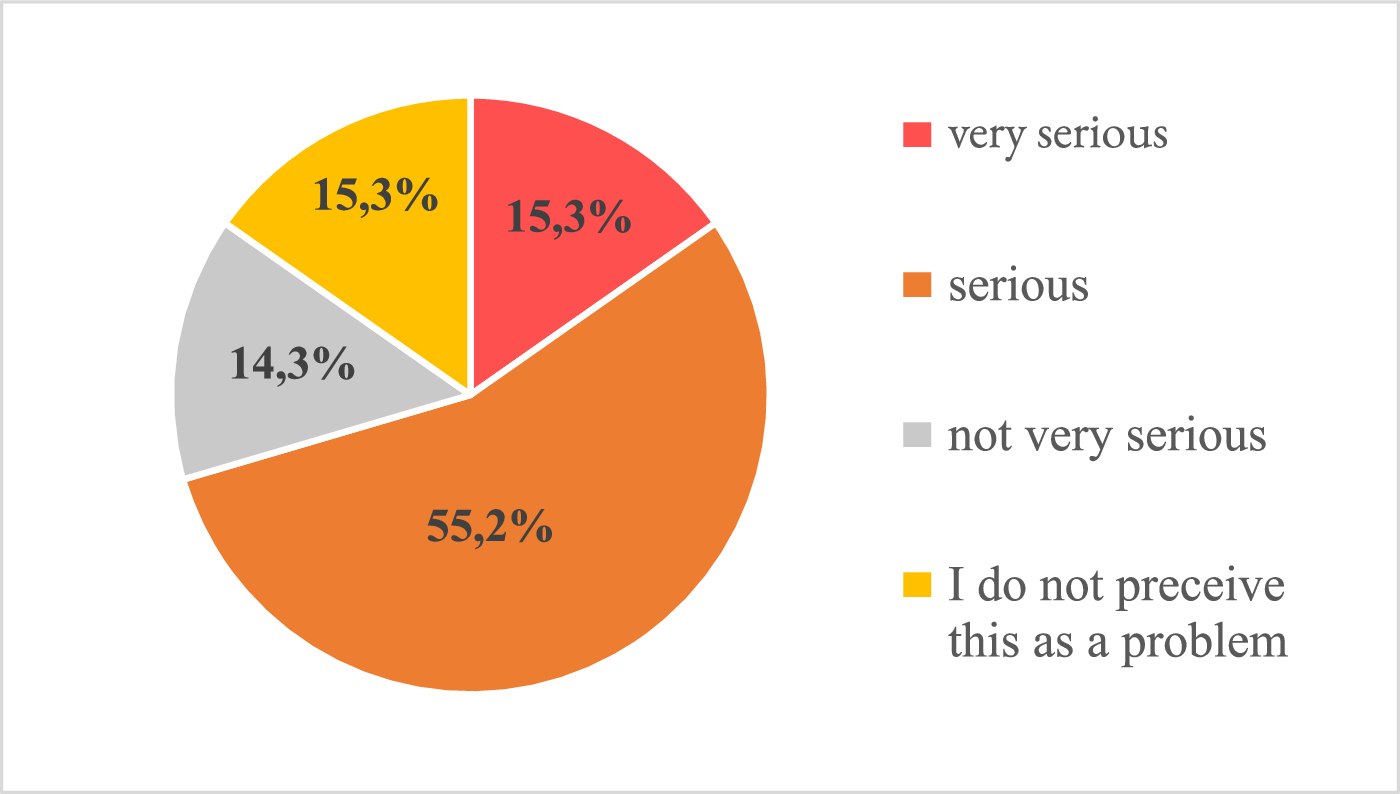
The scale of the problem of unequal treatment of women in the labor market is illustrated in Figure 1. A substantial majority of respondents (70.4%) considered it a serious or very serious problem.
Importantly, the Mann-Whitney U test indicated statistically significant differences between women and men (U = 1825; p < 0.001), with women assigning significantly higher ranks to the severity of the phenomenon than men. These results show that the perception of the scale of unequal treatment of women in the labor market is strongly embedded in gendered experience and perspectives.
At the outset, the research questions appeared relatively self-evident, and the answers seemed largely predictable, particularly regarding the mere perception of unequal treatment of women in the labor market. However, the detailed empirical analysis revealed substantial differences in the perception of this phenomenon when considering socio-demographic characteristics.
The findings indicate that only the respondents’ gender was significantly associated with the perceived presence of unequal treatment of women, with women reporting the phenomenon more frequently than men. This result confirms hypothesis H1, which posited that respondents’ gender significantly differentiates the perception of unequal treatment of women in the labor market.
The results demonstrated that an increase in the scores for structural barriers to development and promotion was associated with a higher probability of perceiving unequal treatment of women, thereby confirming hypothesis H2 (that perception is determined by structural factors, including development and promotion barriers). A similar effect was observed with regard to barriers to labor market entry and re-entry, supporting hypothesis H4. In contrast, H3 – which assumes that the perception of unequal treatment of women in the labor market is determined by interpersonal factors – was not confirmed.
The perception of the state of legal protection for women and men in the labor market also yielded noteworthy insights. Although respondents, regardless of gender, positively evaluated legally guaranteed equality in healthcare, access to education, and the right to pursue an individual career path, signs of differentiation emerged in the latter dimension, with men assessing these rights more favorably than women.
Of particular significance is the evaluation of legal protection concerning women’s employment access, which suggests the persistence of structural barriers limiting women’s labor market participation.
Furthermore, the scale of the problem is illustrated by the fact that over half of the respondents reported familiarity with cases of discrimination against women, whereas only one quarter had encountered discrimination against men. In the Polish context, the perception of the scale of unequal treatment of women in the labor market appears to be strongly embedded in gendered experiences and perspectives.
This finding supports sociological theories suggesting that women and men experience labor market institutions differently because they are exposed to different social expectations, constraints, and opportunities. Consequently, perceptions of inequality are not merely reflections of objective labor market conditions but are also shaped by lived experiences and socially constructed gender roles.27
Several limitations of the present study must be acknowledged. These include the sample size, the sampling method, and the gender structure of the sample, which resulted in an underrepresentation of men. Consequently, the results, particularly those concerning gender-based comparisons, should be interpreted with methodological caution. These results should primarily be regarded as indicative of specific tendencies that require further verification in larger and more balanced samples. Nevertheless, the presented results may serve as a starting point for more in-depth analyses in this field.
The results allow for the formulation of system-level, organizational, and educational recommendations aimed at reducing discrimination against women in the labor market and enhancing the effectiveness of existing legal protection mechanisms.
In particular, increasing transparency in remuneration systems, systematically monitoring wage disparities, and implementing equality-oriented promotion policies and access to managerial positions appear essential. The results clearly indicate that structural factors most strongly increase the likelihood of perceiving discrimination against women.
Overall, it is also necessary to reduce barriers to women’s labor market entry into and return, especially following maternity and parental leave. Measures in this area may include the development of flexible employment arrangements, professional reintegration programs, and institutional mechanisms supporting the return to work after caregiving-related interruptions. The empirical results indicate that this dimension constitutes one of the key determinants shaping the perception of discrimination.
Finally, further comparative research on labor market discrimination, encompassing the experiences of both genders and socio-demographic differentiation, appears warranted. Such research would enable a more comprehensive understanding of the mechanisms underlying inequality and support the design of more targeted and effective public policy interventions.
Projekt ustawy o zmianie ustawy – Kodeks pracy, January 15, 2025. UD183, accessed February 16, 2026, https://www.gov.pl/web/premier/projekt-ustawy-o-zmianie-ustawy-kodeks-pracy.
Ustawa z dnia 26 czerwca 1974 r. – Kodeks pracy. Tekst jednolity. Dz.U. 2023. Poz. 1465 z późn. zm.
Ustawa z dnia 3 grudnia 2010 r. o wdrożeniu niektórych przepisów Unii Europejskiej w zakresie równego traktowania. Tekst jednolity. Dz.U. 2025. Poz. 1452 z późn. zm.
Barbieri, Paolo. “Flexible Employment and Inequality in Europe.” European Sociological Review 25, no. 6 (2009): 621–628. https://doi.org/10.1093/esr/jcp020.
Bogatko, Katarzyna, Anna Drabarz, and Krzysztof Śmiszek. Przeciwko dyskryminacji: Poradnik prawny. Fundacja Fundusz Współpracy, 2013.
Dančíková, Zuzana, and Magda Muter. “Subtle Discrimination of Fathers in Relation to Leave-Taking: A Comparative Study of Slovakia and Poland.” Frontiers in Sociology 10 (2026). https://doi.org/10.3389/fsoc.2025.1709287.
Dyląg, Wojciech. “Wybrane aspekty odpowiedzialności za dyskryminację i nierówne traktowanie w zatrudnieniu.” Bezpieczeństwo Pracy: Nauka i praktyka, no. 8 (2013): 8–11.
Ferrando, Pere J., Fabia Morales-Vives, José M. Casas, and José Muñiz. “Likert Scales: A Practical Guide to Design, Construction and Use.” Psicothema 37, no. 4 (2025): 1–15. https://doi.org/10.70478/psicothema.2025.37.24.
Giddens, Anthony, and Philip W. Sutton. Sociology. 9th ed. Polity Press, 2021.
Grochowski, Robert. “Uprzedzenia i stereotypy, jako narzędzia manipulacji w europejskich mediach.” Fides, Ratio et Patria: Studia toruńskie 20 (2024): 62–74. https://doi.org/10.56583/frp.2694.
Jaworski, Krzysztof. “Zasada równego traktowania a sprzeciw sumienia.” Logos i Ethos 49, no. 1 (2019): 101–121. https://doi.org/10.15633/lie.3437.
Kalinowska-Sufinowicz, Baha. “Teorie dyskryminacji ekonomicznej na rynku pracy a osoby z niepełnosprawnościami.” Niepełnosprawność: Zagadnienia, problemy, rozwiązania, no. 3 (2017): 12–31.
Kamińska, Barbara. “Dyskryminacja jako patologia zarządzania zasobami pracy.” Zarządzanie Innowacyjne w Gospodarce i Biznesie, no. 1 (2015): 97–110.
Kowalewska, Helen. “Gendered Employment Patterns: Women’s Labour Market Outcomes Across 24 Countries.” Journal of European Social Policy 33, no. 2 (2023): 151–168. https://doi.org/10.1177/09589287221148336.
Mohd Rokeman, Nor Roselidyawaty. “Likert Measurement Scale in Education and Social Sciences: Explored and Explained.” EDUCATUM: Journal of Social Sciences, no. 10 (2024): 77–88. https://doi.org/10.37134/ejoss.vol10.1.7.2024.
Perception to Policy: Dismantling Gender Stereotypes in the European Union. Manuscript completed in July 2025. Publications Office of the European Union, 2025.
Sielska, Alicja. “Neoklasyczne teorie dyskryminacji w warunkach konkurencji doskonałej – analiza krytyczna.” Ekonomia: Wroclaw Economic Review 25, no. 3 (2019): 29–41. https://doi.org/10.19195/2084-4093.25.3.3.
Szczepańczyk, Marta. “Determinants of Discrimination Against Women in the Labour Market and Stereotypes in the Perception of Their Social Roles.” Scientific Papers of Silesian University of Technology Organization and Management Series 2024, no. 207 (2024): 521–533. https://doi.org/10.29119/1641-3466.2024.207.29.
Szreder, Mirosław. Metody i techniki sondażowych badań opinii. 2nd ed. Polskie Wydawnictwo Ekonomiczne, 2010.
Tavakol, Mohsen, and Reg Dennick. “Making Sense of Cronbach’s Alpha.” International Journal of Medical Education 2 (2011): 53–55. https://doi.org/10.5116/ijme.4dfb.8dfd.
Walby, Sylvia. Globalization and Inequalities: Complexity and Contested Modernities. SAGE Publications, 2009. https://doi.org/10.4135/9781446269145.
Warszewska-Makuch, Magdalena, and Zofia Mockałło. “Nierówności płci na rynku pracy – przegląd literatury.” Bezpieczeństwo Pracy: Nauka i Praktyka 9 (2019): 15–19.
Winiarska, Aleksandra, and Witold Klaus. “Dyskryminacja i nierówne traktowanie jako zjawisko społeczno-kulturowe.” Studia BAS, no. 2 (2011): 9–40.
“Czym jest dyskryminacja?” Rzecznik Praw Obywatelskich, March 2, 2014. Accessed February 10, 2026. https://bip.brpo.gov.pl/pl/content/czym-jest-dyskryminacja.
Karpiński, Maciej. “Nowe definicje mobbingu i dyskryminacji w Kodeksie pracy: Co się zmieni?” Poradnik Przedsiębiorcy, October 17, 2025. Accessed December 9, 2025. https://poradnikprzedsiebiorcy.pl/-definicje-mobbingu-i-dyskryminacji-w-kodeksie-pracy.
Sosin, Michał. “Czym jest dyskryminacja w miejscu pracy i nierówne traktowanie?” Michał Sosin, January 18, 2024. Accessed February 10, 2026. https://michalsosin.com/blog/dyskryminacja-w-pracy/.
1 Paolo Barbieri, “Flexible Employment and Inequality in Europe,” European Sociological Review 25, no. 6 (2009): 625, https://doi.org/10.1093/esr/jcp020; Baha Kalinowska-Sufinowicz, “Teorie dyskryminacji ekonomicznej na rynku pracy a osoby z niepełnosprawnościami,” Niepełnosprawność: Zagadnienia, problemy, rozwiązania, no. 3 (2017): 12–31.
2 Wojciech Dyląg, “Wybrane aspekty odpowiedzialności za dyskryminację i nierówne traktowanie w zatrudnieniu,” Bezpieczeństwo Pracy: Nauka i praktyka, no. 8 (2013): 8–11; Krzysztof Jaworski, “Zasada równego traktowania a sprzeciw sumienia,” Logos i Ethos 49, no. 1 (2019): 110, https://doi.org/10.15633/lie.3437.
3 Aleksandra Winiarska and Witold Klaus, “Dyskryminacja i nierówne traktowanie jako zjawisko społeczno-kulturowe,” Studia BAS, no. 2 (2011): 33–36; Alicja Sielska, “Neoklasyczne teorie dyskryminacji w warunkach konkurencji doskonałej – analiza krytyczna,” Ekonomia: Wroclaw Economic Review 25, no. 3 (2019): 36, https://doi.org/10.19195/2084-4093.25.3.3.
4 Sylvia Walby, Globalization and Inequalities: Complexity and Contested Modernities (SAGE Publications, 2009), https://doi.org/10.4135/9781446269145.
5 Harriet Bradley, Gender (Polity Press, 2007).
6 Sielska, “Neoklasyczne teorie dyskryminacji w warunkach konkurencji doskonałej – analiza krytyczna,” 38.
7 Anthony Giddens and Philip W. Sutton, Sociology, 9th ed. (Polity Press, 2021); Bradley, Gender.
8 Winiarska and Klaus, “Dyskryminacja i nierówne traktowanie jako zjawisko społeczno-kulturowe,” 25.
9 Katarzyna Bogatko et al., Przeciwko dyskryminacji: Poradnik prawny (Fundacja Fundusz Współpracy, 2013).
10 Michał Sosin, “Czym jest dyskryminacja w miejscu pracy i nierówne traktowanie?,” Michał Sosin, January 18, 2024, accessed February 10, 2026, https://michalsosin.com/blog/dyskryminacja-w-pracy/.
11 Bogatko et al., Przeciwko dyskryminacji.
12 Robert Grochowski, “Uprzedzenia i stereotypy, jako narzędzia manipulacji w europejskich mediach,” Fides, Ratio et Patria: Studia toruńskie 20 (2024): 62–74, https://doi.org/10.56583/frp.2694.
13 Barbara Kamińska, “Dyskryminacja jako patologia zarządzania zasobami pracy,” Zarządzanie Innowacyjne w Gospodarce i Biznesie, no. 1 (2015): 97–110.
14 “Czym jest dyskryminacja?,” Rzecznik Praw Obywatelskich, March 2, 2014, accessed February 10, 2026, https://bip.brpo.gov.pl/pl/content/czym-jest-dyskryminacja.
15 Ustawa z dnia 3 grudnia 2010 r. o wdrożeniu niektórych przepisów Unii Europejskiej w zakresie równego traktowania, tekst jednolity, Dz.U. 2025, poz. 1452 z późn. zm.
16 Ustawa z dnia 26 czerwca 1974 r. – Kodeks pracy, tekst jednolity, Dz.U. 2023, poz. 1465 z późn. zm.
17 Ustawa z dnia 3 grudnia 2010 r. o wdrożeniu niektórych przepisów Unii Europejskiej w zakresie równego traktowania.
18 Projekt ustawy o zmianie ustawy – Kodeks pracy, January 15, 2025, UD183, accessed February 16, 2026, https://www.gov.pl/web/premier/projekt-ustawy-o-zmianie-ustawy-kodeks-pracy. As of the date of this paper, the bill remained in the legislative phase and had not been enacted.
19 Maciej Karpiński, “Nowe definicje mobbingu i dyskryminacji w Kodeksie pracy: Co się zmieni?,” Poradnik Przedsiębiorcy, October 17, 2025, accessed December 9, 2025, https://poradnikprzedsiebiorcy.pl/-definicje-mobbingu-i-dyskryminacji-w-kodeksie-pracy.
20 Kamińska, “Dyskryminacja jako patologia zarządzania zasobami pracy,” 97–110.
22 Mirosław Szreder, Metody i techniki sondażowych badań opinii, 2nd ed. (Polskie Wydawnictwo Ekonomiczne, 2010); Nor Roselidyawaty Mohd Rokeman, “Likert Measurement Scale in Education and Social Sciences: Explored and Explained,” EDUCATUM: Journal of Social Sciences, no. 10 (2024): 80, https://doi.org/10.37134/ejoss.vol10.1.7.2024; Pere J. Ferrando et al., “Likert Scales: A Practical Guide to Design, Construction and Use,” Psicothema 37, no. 4 (2025): 8, https://doi.org/10.70478/psicothema.2025.37.24.
23 Mohsen Tavakol and Reg Dennick, “Making Sense of Cronbach’s Alpha,” International Journal of Medical Education 2 (2011): 53–55, https://doi.org/10.5116/ijme.4dfb.8dfd.
24 Marta Szczepańczyk, “Determinants of Discrimination Against Women in the Labour Market and Stereotypes in the Perception of Their Social Roles,” Scientific Papers of Silesian University of Technology Organization and Management Series 2024, no. 207 (2024): 521–533, https://doi.org/10.29119/1641-3466.2024.207.29.
25 Walby, Globalization and Inequalities.
26 Magdalena Warszewska-Makuch and Zofia Mockałło, “Nierówności płci na rynku pracy – przegląd literatury,” Bezpieczeństwo Pracy: Nauka i Praktyka 9 (2019): 15–19; Szczepańczyk, “Determinants of Discrimination Against Women in the Labour Market and Stereotypes in the Perception of Their Social Roles,” 528–533; Perception to Policy: Dismantling Gender Stereotypes in the European Union, Manuscript completed in July 2025 (Publications Office of the European Union, 2025); Zuzana Dančíková and Magda Muter, “Subtle Discrimination of Fathers in Relation to Leave-Taking: A Comparative Study of Slovakia and Poland,” Frontiers in Sociology 10 (2026), https://doi.org/10.3389/fsoc.2025.1709287.
27 Walby, Globalization and Inequalities; Helen Kowalewska, “Gendered Employment Patterns: Women’s Labour Market Outcomes Across 24 Countries,” Journal of European Social Policy 33, no. 2 (2023): 425–441, https://doi.org/10.1177/09589287221148336.