
19, nr 1 (2026): 403–418
https://doi.org/10.56583/fs.3122
nadesłano: 21 kwietnia 2026 | zaakceptowano: 14 maja 2026
Licencja CC BY-NC-SA 4.0
ISSN: 1899-3109; eISSN: 2956-4085
PSYCHOLOGIA
PSYCHOLOGY
Dr. Mateusz Barłóg
Medical University of Lublin
e-mail: mateusz.barlog@umlub.edu.pl
https://orcid.org/0000-0002-3966-159X
Wojciech Buda
e-mail: wojciech.budakontakt@gmail.com
https://orcid.org/0009-0009-7073-3473
Patrycja Jakubaszek
Medical University of Lublin
e-mail: patrycja.jakubaszek@umlub.edu.pl
https://orcid.org/0009-0002-4970-1783
Mikrotransakcje oraz zachowania hazardowe w grach cyfrowych – uwarunkowania i profilaktyka w kontekście teorii pozytywnego rozwoju młodzieży
Summary
Objective: The objective of this article is to analyze the mechanisms underlying the function of loot boxes in video games and their potential links to gambling-like behaviors among children and adolescents.
Method: A review of the literature on current research findings and reports was conducted, and the development of microtransactions in the gaming industry was characterized, with particular emphasis on the mechanics of random reward boxes and their structural similarities to games of chance. Selected psychological and behavioral mechanisms were discussed, as well as developmental factors, such as limited impulse control and peer influence.
Results: Based on this analysis, a theoretical model of the behavioral cycle associated with opening loot boxes was developed. Preventive measures were also proposed, incorporating an approach based on Positive Youth Development (PYD), highlighting the need to limit exposure to gambling-like mechanisms by strengthening adolescents’ psychosocial competencies.
Conclusions: The analysis indicates that loot box mechanisms, present in many popular video games, exhibit significant similarities to classic gambling systems based on randomness and reinforcement contingencies.
Keywords: gambling; loot boxes; microtransactions; adolescents; video games; behavioral addictions; Positive Youth Development
Streszczenie
Cel: Celem artykułu jest analiza mechanizmów związanych z funkcjonowaniem lootboxów w grach wideo oraz ich potencjalnych powiązań z zachowaniami o charakterze hazardowym wśród dzieci i młodzieży.
Metoda: Dokonano przeglądu literatury aktualnych wyników badań, raportów oraz scharakteryzowano rozwój mikrotransakcji w branży gier, ze szczególnym uwzględnieniem mechaniki losowych skrzynek z nagrodami oraz ich strukturalnych podobieństw do gier losowych. Omówiono wybrane mechanizmy psychologiczne i behawioralne, a także czynniki rozwojowe, takie jak ograniczona kontrola impulsów czy wpływ grupy rówieśniczej.
Wyniki: Na tej podstawie opracowano model teoretyczny cyklu zachowań związanych z otwieraniem lootboxów. Przedstawiono także kierunki działań profilaktycznych, uwzględniające podejście oparte na pozytywnym rozwoju młodzieży, wskazując na konieczność ograniczania ekspozycji na mechanizmy hazardopodobne poprzez wzmacnianie kompetencji psychospołecznych nastolatków.
Wnioski: Przeprowadzona analiza wskazuje, że mechanizmy typu lootbox, obecne w wielu popularnych grach wideo, wykazują istotne podobieństwa do klasycznych mechanizmów hazardowych, opartych na losowości i systemach wzmocnień.
Słowa kluczowe: hazard; lootboxy; miktrotransakcje; młodzież; gry wideo; uzależnienia behawioralne; pozytywny rozwój młodzieży
The widespread availability of the Internet may, in retrospect, be regarded as one of the defining transformative phenomena of modernity, exerting a profound influence on contemporary social, cultural, and technological realities. The early stages of Internet development, both globally and within Poland, were relatively limited in scope and largely experimental in nature. At that time, it was difficult to anticipate that a computer network, initially designed to facilitate communication processes, would, over subsequent decades, evolve into an infrastructure permeating nearly all domains of human functioning, substantially reshaping patterns of work, interpersonal communication, and the organization of leisure time.
According to the global We Are Social1 report, an increasing proportion of individuals utilize internet-enabled devices to maintain social connectedness, remain informed about global events, and engage in entertainment-oriented activities. It is estimated that more than 5.56 billion individuals – approximately 67.9% of the global population – have access to the internet. Compared with the previous year,2 this figure has increased by 136 million users (an approximate growth of 2.5%). The global average daily duration of internet use for a typical user is approximately 6 hours and 38 minutes. The overwhelming majority of users (approximately 96.3%) access the internet via smartphones or other mobile devices (e.g., tablets), as well as laptops or desktop computers (approximately 61.5%), indicating that a substantial proportion of users possesses multiple internet-enabled devices. Data from the Digital 2026 Poland3 report indicate that approximately 34.1 million individuals in Poland – around 90% of the national population4 – use the internet, with approximately 53.8 million connected devices currently in operation.
Of particular relevance is the observation that regular internet use is being initiated at progressively younger ages. Agnieszka Rowicka and Michał Bujalski5 report that the mean age of initial exposure to mobile device use among children is 2 years and 2 months. Comparable findings have been reported by the CBOS Foundation,6 indicating that approximately one-third of children aged between 12 and 23 months use mobile devices, as do roughly two-thirds of children aged 2 to 5 years. The majority of children (approximately 75%) use internet-enabled devices primarily for passive and entertainment-oriented activities, such as watching videos, animated content, engaging with coloring applications, and playing games. The average daily screen time for children aged 0–6 exceeds one hour.7
In contrast, the mean daily duration of internet use among adolescents aged 15–19 is approximately 4 hours and 59 minutes. Among primary school students, the corresponding figures are approximately 4 hours and 18 minutes for seventh-grade students and 4 hours and 46 minutes for eighth-grade students.8 Children under the age of eight typically access devices belonging to parents or caregivers. The average age at which Polish children receive their own internet-enabled device, such as a smartphone, is approximately 8 years and 5 months.9 While in some instances such devices are provided to facilitate parent-child communication (e.g., upon school entry or in the context of parental separation), they have increasingly become normative gifts for ceremonial occasions (e.g., First Communion or Christmas). Social normative pressures associated with peer group dynamics also constitute a significant contributing factor, particularly when device ownership is already established among peers.10
In contemporary society, possession of an internet-enabled device has become functionally normative for maintaining technological literacy, accessing information, and fulfilling occupational demands. Although this development confers numerous benefits, the internet, particularly as a medium of entertainment, also entails a range of risks to which children and adolescents remain disproportionately susceptible due to developmental and psychosocial vulnerabilities.
According to video game industry specialists, the emergence of microtransactions can be traced back to the early 2000s.11 One of the first globally recognized instances was the purchase of additional horse armor in The Elder Scrolls IV: Oblivion, developed by Bethesda Game Studios, now part of Microsoft. Since that time, game developers have increasingly expanded monetization strategies by offering players the option to purchase additional in-game items, bonuses, or services using real-world currency mechanisms now formally conceptualized as “microtransactions.”12
Such mechanisms may be purely cosmetic, exerting no functional influence on gameplay, or may confer instrumental advantages by significantly increasing the probability of in-game success or competitive dominance. Within this framework, the player as a consumer agent is confronted with a conventional purchasing decision, involving the acquisition of a clearly specified product or service in exchange for a predetermined monetary cost. Importantly, in this transactional model, the outcome of the purchase is transparent and predictable.
A distinct category of microtransactions is constituted by “loot boxes,” defined as purchasable virtual containers that yield a randomized assortment of in-game items.13 These may be acquired using either in-game currency or real-world financial resources. In contrast to standard microtransactions, the player engages in a probabilistic exchange characterized by outcome uncertainty, as the specific content of the loot box remains unknown prior to purchase. The reward is determined through stochastic processes and is associated with variable subjective and market value, rendering the transaction potentially either advantageous or disadvantageous from the player’s perspective.
In certain game architectures, access to loot box contents is further contingent upon the possession of a virtual “key,” which itself may require additional purchase, thereby introducing a layered monetization structure. The opening of a loot box is typically accompanied by highly salient audiovisual stimuli, including dynamic animations, intensified color saturation (often shifting towards warmer tones), and reinforcing verbal cues such as “congratulations,” or “you have won.” These design elements are not incidental; rather, they function as operant conditioning stimuli, amplifying anticipatory arousal and reinforcing reward-seeking behavior.
To provide a structured overview of transactional mechanisms in online gaming environments, fifteen of the most frequently engaged game genres were identified, alongside representative titles. A systematic review of the prevalence of microtransactions and loot box mechanics within these genres was conducted; detailed findings are presented in Table 1.
| Game Genre | Percentage of Users [%] | Three Example Popular Games Within Each Category (as of March 10, 2026) | Does the Listed Game Feature Microtransactions or an Embedded In-Game Store System? | Do Loot Box Mechanisms / Gambling-Like Mechanics Occur in the Specified Game? |
| FPS/TPS | 51.90 | 1.
Counter
Strike
2
2. Call of Duty: Modern Warfare III 3. Battlefield 6 | 1.
Yes 2. Yes 3. Yes | 1. Yes 2. Yes 3. Yes |
| Adventure | 48.90 | 1.
Dispatch
2. Resident Evil Requiem 3. GTA V | 1. No 2. No 3. Yes | 1. No 2. No 3. Yes |
| Sport | 35.40 | 1.
EA
Sports
FC
2026
2. EA Sports Madden NFL 26 3. NBA 2K26 | 1.
Yes 2. Yes 3. Yes | 1.
Yes 2. Yes 3. Yes |
| MOBA* | 34.20 | 1.
League
of
Legends
2. DOTA 2 3. Smite | 1.
Yes 2. Yes 3. Yes | 1.
No 2. Yes 3. No |
| Racing | 33.00 | 1.
Gran
Turismo
7
2. F1 25 3. Forza Horizon 5 | 1.
Yes 2. Yes 3. Yes | 1.
No 2. No 3. No |
| Logic | 32.70 | 1.
Candy
Crush
Saga
2. Tetris Effect: Connected 3. Sudoku Master | 1.
Yes 2. No 3. Yes | 1.
Yes 2. No 3. No |
| Simulation | 32.30 | 1.
The
Sims
4
2. Euro Truck Simulator 2 3. Stardew Valley | 1.
Yes 2. No 3. No | 1.
No 2. No 3. No |
| Strategy | 30.70 | 1.
Civilization
VII
2. Europa Universalis 5 3. StarCraft II | 1.
Yes 2. Yes 3. Yes | 1.
No 2. No 3. No |
| Platform | 28.00 | 1.
Ori
and
the
Will
of
the
Wisps 2
2. Hollow Knight: Silksong 3. Rayman Legends 2 | 1.
No 2. No 3. No | 1.
No 2. No 3. No |
| Fighting | 27.80 | 1.
Tekken
8
2. Mortal Kombat 11 3. Street Fighter 6 | 1.
Yes 2. Yes 3. Yes | 1.
No 2. No 3. No |
| Battle Royale | 27.70 | 1.
PUBG:
Battlegrounds
2. Fortnite 3. Call of Duty: Warzone | 1.
Yes 2. Yes 3. Yes | 1.
Yes 2. No 3. Yes |
| RPG | 26.10 | 1.
Path
of
Exile
2
2. Diablo IV 3. Lost Ark | 1.
Yes 2. Yes 3. Yes | 1.
No 2. No 3. Yes |
| Role Play/ Sandbox | 24.50 | 1.
Roblox
2. Minecraft 3. Terraria | 1.
Yes 2. Yes 3. Yes | 1.
Yes 2. No 3. No |
| Party | 23.40 | 1.
Fall
Guys
2. Among Us 3. Pummel Party | 1.
Yes 2. Yes 3. No | 1.
No 2. No 3. No |
| MMO** | 23.30 | 1.
Black
Desert
Online
2. Final Fantasy XVI 3. World of Warcraft | 1.
Yes 2. Yes 3. Yes | 1.
No 2. No 3. No |
Of the 45 analyzed games, 36 incorporate microtransactions (80%), whereas 9 do not include any monetization system (20%). Furthermore, 13 titles within the sample feature loot box mechanics (29%). These findings indicate that the majority of games engaged with by adolescents enable the expenditure of real-world financial resources on virtual goods available within in-game marketplaces. Such goods may include various forms of character enhancements, so-called “cosmetic” items (i.e., modifications affecting the visual appearance of characters or objects), as well as functional add-ons and “boosters” that increase experience gain rates or temporarily augment in-game competencies.
In games featuring loot box systems (also referred to colloquially by players as “crates,” “cases,” or “boxes”), developers actively incentivize engagement through multiple behavioral design strategies. These include the implementation of in-game pop-up prompts, the distribution of loot boxes as rewards for completing routine tasks (e.g., “daily quests”), and the provision of virtual currency earned through gameplay activity or randomized in-game events. Such mechanisms collectively function as reinforcement schedules, systematically shaping user engagement patterns and increasing the salience of reward anticipation.
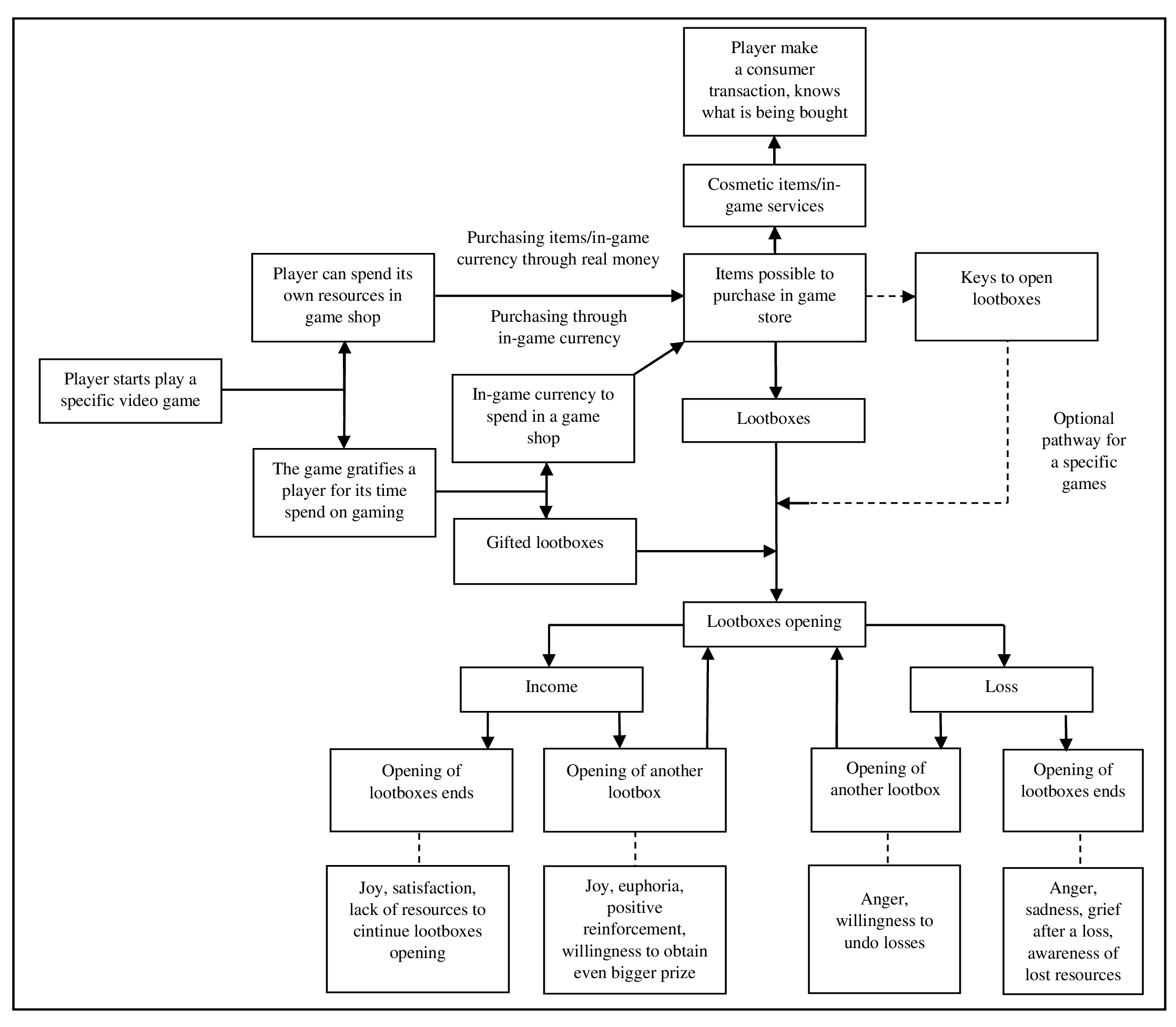
The theoretical model outlined below presents a generalized representation of player behavior in relation to loot box engagement, alongside the structural mechanics underpinning these systems within video games.
In order to more comprehensively conceptualize the psychosocial mechanisms associated with loot box engagement, a theoretical model was developed.
Figure 1 presents an original conceptual model illustrating the mechanisms underlying loot box engagement among children and adolescents. In instances where a gain is achieved, the player may discontinue further engagement; however, there remains a probability of continued play due to the operation of positive reinforcement mechanisms.14
Conversely, following losses, players may terminate loot box engagement, experiencing regret alongside an awareness of depleted resources. However, in such circumstances, there is a heightened risk of the emergence of loss-recovery motivation, which may precipitate continued engagement through the purchase and opening of additional loot boxes. This behavioral pattern may be further reinforced by subsequent losses. Such dynamics exhibit characteristics consistent with the gambler’s fallacy,15 defined as the erroneous belief that the likelihood of a favorable outcome increases following a sequence of unfavorable events, despite the independence of probabilistic events. Consequently, this cognitive distortion may motivate individuals to persist in gameplay in an attempt to recuperate prior losses.
 Source: Created by the author.
The purchase and opening of loot boxes are strongly associated with gambling-related mechanisms, functioning in a manner analogous to online casino systems.16 Within this context, young individuals should be conceptualized as a population at elevated risk of developing gambling-related problems. Children, in particular, may be especially vulnerable due to underdeveloped capacities for cost evaluation17 and difficulties in comprehending probabilistic structures,18 such as the statistical likelihood of obtaining specific rewards. In addition, a decreased sense of self-control19 and a lack of developmental resources20 increase the probability of risky loot box use among children and youth.
For a given behavior to be classified as gambling, three core components must be present:21
In the case of loot boxes, all of the above criteria are satisfied; however, children and adolescents may experience difficulties in accurately estimating the subjective and objective value of the wager involved. It is also noteworthy that some games incorporating loot box mechanics operate on a zero-entry barrier model, requiring no payment for download, installation, or initial gameplay, thereby increasing accessibility among younger users.
A further salient risk factor is the influence of peer group dynamics and the need for social affiliation,22 which is particularly pronounced during adolescence.23 The social aspect is also important in video games with an online component, because one of the triggers to open loot boxes is driven by the desire to maintain status, respectability, and appreciation among other players24 in connection with the loot obtained from cases. These influences may manifest both as direct encouragement to engage with loot box systems and as perceived normative pressure to conform to group behaviors, wherein participation in specific games constitutes a marker of social belonging.
Considering the average daily duration of engagement with online gaming among children and adolescents, it is essential to address their exposure to mechanisms involving real-world financial expenditure, as well as associated risk behaviors. Adolescents, in particular, demonstrate an increased propensity for risk-taking behaviors due to ongoing physical, psychological, and social developmental processes.25
An additional risk factor may be maladaptive daydreaming, conceptualized as excessive and difficult-to-control fantasy activity that functions as a form of psychological escape from reality.26 Within the context of video games, particularly those offering immersive virtual environments and reward-based systems, there exists the potential for the reinforcement of escapist tendencies.27 For children and adolescents, whose emotional regulation and impulse control capacities remain under development, this may result in excessive engagement in virtual environments at the expense of social and educational functioning.
In light of the above, it is imperative to implement preventive strategies that not only mitigate risk but also support normative developmental trajectories. One of the central frameworks in this domain is the Positive Youth Development (PYD) approach, which emphasizes the strengthening of individual assets rather than solely focusing on the reduction of problem behaviors.28Within this framework, the “Five Cs” model is distinguished, encompassing five key developmental domains: competence, confidence, connection, character, and caring. The enhancement of these domains may serve a protective function, reducing adolescents’ susceptibility to engaging in risk behaviors,29 including excessive interaction with loot box mechanisms and associated gambling-like behavioral patterns.
From a preventive perspective, it is also essential to consider the broader developmental ecology of the child. Young individuals’ functioning is not confined to individual predispositions but occurs within multiple interacting systems, including the family, school, and peer group.30 These contexts play a critical role in shaping behavioral patterns, emotional regulation strategies, and decision-making processes, including those related to financial behaviors in gaming environments.
The family constitutes a particularly significant developmental context, serving as the primary environment in which children acquire early social experiences and learn through the observation and imitation of significant adults.31 Consistent behavioral modelling, effective communication, and the establishment of supportive, trust-based relationships may function as protective factors against engagement in risk behaviors, including the excessive use of loot box systems.32
Equally important is the role of schools and other educational institutions, which, in collaboration with families, can support the development of adolescents’ psychosocial competencies.33 Of particular relevance is the cultivation of critical thinking skills, an understanding of probabilistic mechanisms, and the capacity for informed consumer decision-making.
The literature also emphasizes the importance of a systemic approach, which assumes cooperation among various stakeholders involved in the child’s development.34 Effective preventive strategies should not be limited to the individual but should encompass the broader social environment. Consistency in educational and developmental influences across contexts (e.g., home and school) enhances intervention effectiveness and facilitates the internalization of norms and values.35
From a prevention standpoint, this necessitates not only limiting access to potentially harmful in-game mechanisms but, more importantly, strengthening both individual and environmental resources. This includes fostering meaningful interpersonal relationships and developing adaptive emotional regulation strategies. Rather than relying solely on restrictive measures (e.g., prohibiting device use), it is essential to provide engaging and developmentally appropriate alternatives for leisure activities, thereby ensuring that digital media do not become the sole means of mood regulation or identity exploration.
The integration of the Positive Youth Development36 framework with systemic interventions may constitute an effective strategy for mitigating the adverse effects associated with loot box engagement. Accordingly, effective prevention should combine the reduction of exposure to high-risk mechanisms with the enhancement of adolescents’ psychosocial competencies within their everyday environments, while simultaneously promoting high-quality family relationships and providing attractive, engaging alternatives for leisure. Such an approach reduces the likelihood that gaming becomes a dominant or exclusive coping strategy for developmental challenges.
The conducted analysis indicates that loot box mechanisms, present in numerous popular video games, exhibit significant structural and functional similarities to classical gambling systems, particularly those based on stochastic processes and reinforcement contingencies. Children and adolescents constitute a particularly vulnerable population due to developmental limitations in risk appraisal and impulse control. Additional factors, such as the need for social belonging and tendencies toward escapism, may further intensify engagement in such activities. Consequently, preventive efforts should focus not only on restricting access to potentially harmful mechanisms but also on strengthening the psychosocial resources of young individuals and their developmental environments. Particular emphasis should be placed on approaches grounded in the Positive Youth Development framework, as well as on systemic collaboration involving the family, school, and peer group.
Aronson, Elliot, Wilson. Timothy D., Robin M. Akert, and Samuel R. Sommers. Social Psychology. 9th ed. Always Learning. Pearson, 2015.
Bakiera, Lucyna. “Wychowanie i rodzicielstwo, styl wychowania i styl rodzicielski: Analiza terminologiczna.” Psychologia Wychowawcza 58, no. 16 (2019): 60–72. https://doi.org/10.5604/01.3001.0013.6361.
Barłóg, Mateusz. “The Family as a Key Context for Positive Youth Development: Legal, Organizational, and Psychological Opportunities for Integrating the Family Into the Network of Support and Development of Adolescents.” Kwartalnik Naukowy Fides et Ratio 57, no. 1 (2024): 25–30. https://doi.org/10.34766/fetr.v57i1.1258.
Barłóg, Mateusz. “The Theory of Positive Youth Development: Polish Adaptation of the PYD-SF and PYD-VSF Questionnaires.” Kwartalnik Naukowy Fides et Ratio 53, no. 1 (2023): 77–84. https://doi.org/10.34766/fetr.v53i1.1146.
Benson, Peter L., Peter C. Scales, Stephen F. Hamilton, and Arturo Sesma. “Positive Youth Development: Theory, Research, and Applications.” in Theoretical Models of Human Development: Theoretical Models of Human Development. Vol. 1 of Handbook of Child Psychology, edited by Richard M. Lerner and William Damon. Wiley, 2007. https://doi.org/10.1002/9780470147658.chpsy0116.
Boyd, Denise Roberts, and Helen L. Bee. Lifespan Development. 8th ed. Pearson, 2019.
Bronfenbrenner, Urie. Ecology of Human Development: Experiments by Nature and Design. Harvard University Press, 2009.
Cialdini, Robert B. Wywieranie wpływu na ludzi: Teoria i praktyka. 7th ed. Translated by Bogdan Wojciszke. GWP, 2024.
Cudo, Andrzej, Jonathan David, Bernadeta Lelonek-Kuleta, Rafał P. Bartczuk, and Matthew T. Keough. “When Gaming Becomes Like Gambling: The Role of Flow, Immersion, Craving, and Self-control in Risky Loot Box use among Polish gamers.” Journal of Gambling Studies, 2026. https://doi.org/10.1007/s10899-025-10472-1.
Delfabbro, Paul H., and Daniel L. King. “Adolescent gambling.” in Adolescent Addiction, 2nd ed., 159–183. Elsevier, 2020. https://doi.org/10.1016/b978-0-12-818626-8.00006-2.
Durlak, Joseph A., Rebecca D. Taylor, Kei Kawashima, et al. “Effects of Positive Youth Development Programs on School, Family, and Community Systems.” American Journal of Community Psychology 39, nos. 3–4 (2007): 269–286. https://doi.org/10.1007/s10464-007-9112-5.
Lange, Rafał, Agnieszka Wrońska, Agnieszka Ładna, et al. Nastolatki 3.0: Raport z ogólnopolskiego badania uczniów i rodziców. Edited by Rafał Lange. NASK; Państwowy Instytut Badawczy, 2025. Accessed April 15, 2026. https://cyberprofilaktyka.pl/badania/Thinkstat_RAPORT_nastolatki-3_0_ONLINE.pdf.
Lerner, Richard M., Jacqueline V. Lerner, Jason B. Almerigi, et al. “Positive Youth Development, Participation in Community Youth Development Programs, and Community Contributions of Fifth-Grade Adolescents: Findings from the First Wave of the 4-H Study of Positive Youth Development.” The Journal of Early Adolescence 25, no. 1 (2005): 17–71. https://doi.org/10.1177/0272431604272461.
Ładna, Agnieszka, Karol Kamiński, Konrad Rosłaniec, et al. Nastolatki: Raport z ogólnopolskiego badania uczniów i rodziców – raport badawczy. Edited by Agnieszka Ładna. NASK – Państwowy Instytut Badawczy, 2025. https://www.nask.pl/media/2025/09/Nastolatki_RAPORT-2.pdf.
Maslow, Abraham H. Motivation and Personality: Unlocking Your Inner Drive and Understanding Human Behavior. Prabhat Prakashan, 2023.
Moskalewicz, Jacek, Barbara Badora, Michał Feliksiak, et al. Oszacowanie rozpowszechnienia oraz identyfikacja czynników ryzyka i czynników chroniących hazardu i innych uzależnień behawioralnych – edycja 2018/2019: Raport z badań. CBOS, May 2019. https://kcpu.gov.pl/wp-content/uploads/2022/11/oszacowanie-rozpowszechnienia-oraz-identyfikacja-czynnikow-ryzyka-czynnikow-chroniacych-hazardu-innych-uzaleznien-behawioralnych-edycja-2018-2019.pdf.
Newall, Philip. “Beyond Gambling: The Dangers of Analogistic Reasoning in Addiction Science, and How Loot Box Psychology Should Create Its Own Unique Theory.” Addiction Research & Theory 32, no. 5 (2023): 319–324. https://doi.org/10.1080/16066359.2023.2279082.
Ostaszewski, Krzysztof. Zachowania ryzykowne młodzieży w perspektywie mechanizmów resilience. Instytut Psychiatrii i Neurologii, 2014.
Plopa, Mieczysław. Psychologia rodziny: Teoria i badania. 6th ed. Oficyna Wydawnicza ”Impuls”, 2011.
Przeperski, Jarosław. “Nowe paradygmaty w obszarze wsparcia rodziny w środowisku lokalnym w perspektywie umieszczania dzieci w pieczy zastępczej.” in “Pedagogika.” Acta Universitatis Nicolai Copernici 34 (2018): 103–119. https://doi.org/10.12775/aunc_ped.2017.017.
Roney, Christopher J. R., and Lana M. Trick. “Grouping and Gambling: A Gestalt Approach to Understanding the Gambler’s Fallacy.” Canadian Journal of Experimental Psychology 57, no. 2 (2003): 69–75. https://doi.org/10.1037/h0087414.
Rose, I. Nelson, and Robert A. Loeb. Blackjack and the Law. RGE Publications, 1998.
Sharma, Prerna, and Ananya Mahapatra. “Phenomenological Analysis of Maladaptive Daydreaming Associated with Internet Gaming Addiction: A Case Report.” General Psychiatry 34, no. 2 (2021): e100419. https://doi.org/10.1136/gpsych-2020-100419.
Skinner, Burrhus F. Science and Human Behavior. B. F. Skinner Foundation, 2005.
Somer, Eli. “Maladaptive Daydreaming: A Qualitative Inquiry.” Journal of Contemporary Psychotherapy 32, nos. 2–3 (2002): 197–212. https://doi.org/10.1023/a:1020597026919.
Steinberg, Laurence. “A Social Neuroscience Perspective on Adolescent Risk-Taking.” in Biosocial Theories of Crime, edited by Kevin M. Beaver and Anthony Walsh. Routledge, 2017.
Sunstein, Cass R. “Probability Neglect: Emotions, Worst Cases, and Law.” The Yale Law Journal 112, no. 1 (2002): 61–107. https://doi.org/10.2307/1562234.
Tomić, Nenad Zoran. “Economic Model of Microtransactions in Video Games.” Journal of Economic Science Research 1, no. 1 (2019): 17–23. https://doi.org/10.30564/jesr.v1i1.439.
Vasta, Ross, Marshall M. Haith, and Scott A. Miller. Psychologia dziecka. 3rd ed. Edited by Anna Matczak. Translated by Małgorzata Babiuch [i in.] Wydawnictwa Szkolne i Pedagogiczne, 2004.
Walęcka-Matyja, Katarzyna. “Role i funkcje rodziny.” in Psychologia rodziny, edited by Iwona Janicka and Hanna Liberska, 96–114. Wydawnictwo Naukowe PWN, 2014.
Wardle, Heather, and David Zendle. “Loot Boxes, Gambling, and Problem Gambling Among Young People: Results from a Cross-Sectional Online Survey.” Cyberpsychology, Behavior, and Social Networking 24, no. 4 (2021): 267–274. https://doi.org/10.1089/cyber.2020.0299.
Xiang, Guo-Xing, Xiong Gan, Xin Jin, Yan-Hong Zhang, and Cong-Shu Zhu. “Developmental Assets, Self-Control and Internet Gaming Disorder in Adolescence: Testing a Moderated Mediation Model in a Longitudinal Study.” Frontiers in Public Health 10 (2022): 808264. https://doi.org/10.3389/fpubh.2022.808264.
Zendle, David, Rachel Meyer, and Nick Ballou. “The Changing Face of Desktop Video Game Monetisation: An Exploration of Exposure to Loot Boxes, Pay to Win, and Cosmetic Microtransactions in the Most-Played Steam Games of 2010–2019.” edited by José C. Perales. PLOS ONE 15, no. 5 (2020): e0232780. https://doi.org/10.1371/journal.pone.0232780.
Zendle, David, Rachel Meyer, Paul Cairns, Stuart Waters, and Nick Ballou. “The Prevalence of Loot Boxes in Mobile and Desktop Games.” Addiction 115, no. 9 (February 2020): 1768–1772. https://doi.org/10.1111/add.14973.
Zimbardo, Philip G., and Richard J. Gerrig. Psychologia i życie. 4th ed. Edited by Maria Materska. Translated by Ewa Czerniawska, Małgorzata Guzowska-Dąbrowska, Aleksandra Jaworska-Surma, and Józef Radzicki. Wydawnictwo Naukowe PWN, 2024.
“Digital 2025: Global Overview Report.” The Essential Guide to the World’s Connected Behaviours. We Are Social, 2025. Accessed April 15, 2026. https://wearesocial.com/wp-content/uploads/2025/02/GDR-2025-v2.pdf.
Główny Urząd Statystyczny. “Sytuacja społeczno-gospodarcza kraju w 2025 r.,” January 30, 2026. https://stat.gov.pl/obszary-tematyczne/inne-opracowania/informacje-o-sytuacji-spoleczno-gospodarczej/sytuacja-spoleczno-gospodarcza-kraju-w-2025-r-,1,164.html#.
Kemp, Simon. “Digital 2024: Global Overview Report.” The Essential Guide to the World’s Connected Behaviours. Datareportal, 2024. Accessed April 15, 2026. https://datareportal.com/reports/digital-2024-global-overview-report.
Kemp, Simon. “Digital 2026: Poland.” Datareportal, November 8, 2025. Accessed April 15, 2026. https://datareportal.com/reports/digital-2026-poland.
Rowicka, Magdalena, and Michał Bujalski. Raport z badania: “Brzdąc w sieci – zjawisko korzystania z urządzeń mobilnych przez dzieci w wieku 0–6 lat”. Akademia Pedagogiki Specjalnej im. Marii Grzegorzewskiej, 2020. https://www.kbpn.gov.pl/portal?id=15&res_id=11479398.
1 “Digital 2025: Global Overview Report,” The Essential Guide to the World’s Connected Behaviours, We Are Social, 2025, accessed April 15, 2026, https://wearesocial.com/wp-content/uploads/2025/02/GDR-2025-v2.pdf.
2 Simon Kemp, “Digital 2024: Global Overview Report,” The Essential Guide to the World’s Connected Behaviours, Datareportal, 2024, accessed April 15, 2026, https://datareportal.com/reports/digital-2024-global-overview-report.
3 Simon Kemp, “Digital 2026: Poland,” Datareportal, November 8, 2025, accessed April 15, 2026, https://datareportal.com/reports/digital-2026-poland.
4 Główny Urząd Statystyczny, “Sytuacja społeczno-gospodarcza kraju w 2025 r.,” January 30, 2026, https://stat.gov.pl/obszary-tematyczne/inne-opracowania/informacje-o-sytuacji-spoleczno-gospodarczej/sytuacja-spoleczno-gospodarcza-kraju-w-2025-r-,1,164.html#.
5 Magdalena Rowicka and Michał Bujalski, Raport z badania: “Brzdąc w sieci – zjawisko korzystania z urządzeń mobilnych przez dzieci w wieku 0–6 lat” (Akademia Pedagogiki Specjalnej im. Marii Grzegorzewskiej, 2020), https://www.kbpn.gov.pl/portal?id=15&res_id=11479398.
6 Jacek Moskalewicz et al., Oszacowanie rozpowszechnienia oraz identyfikacja czynników ryzyka i czynników chroniących hazardu i innych uzależnień behawioralnych – edycja 2018/2019: Raport z badań (CBOS, May 2019), https://kcpu.gov.pl/wp-content/uploads/2022/11/oszacowanie-rozpowszechnienia-oraz-identyfikacja-czynnikow-ryzyka-czynnikow-chroniacych-hazardu-innych-uzaleznien-behawioralnych-edycja-2018-2019.pdf.
7 Rowicka and Bujalski, Raport z badania: “Brzdąc w sieci – zjawisko korzystania z urządzeń mobilnych przez dzieci w wieku 0–6 lat”.
8 Agnieszka Ładna et al., Nastolatki: Raport z ogólnopolskiego badania uczniów i rodziców – raport badawczy, ed. Agnieszka Ładna (NASK – Państwowy Instytut Badawczy, 2025), https://www.nask.pl/media/2025/09/Nastolatki_RAPORT-2.pdf.
9 Rafał Lange et al., Nastolatki 3.0: Raport z ogólnopolskiego badania uczniów i rodziców, ed. Rafał Lange (NASK; Państwowy Instytut Badawczy, 2025), accessed April 15, 2026, https://cyberprofilaktyka.pl/badania/Thinkstat_RAPORT_nastolatki-3_0_ONLINE.pdf.
10 Ładna et al., Nastolatki.
11 David Zendle et al., “The Changing Face of Desktop Video Game Monetisation: An Exploration of Exposure to Loot Boxes, Pay to Win, and Cosmetic Microtransactions in the Most-Played Steam Games of 2010–2019,” ed. José C. Perales, PLOS ONE 15, no. 5 (2020): e0232780, https://doi.org/10.1371/journal.pone.0232780.
12 Nenad Zoran Tomić, “Economic Model of Microtransactions in Video Games,” Journal of Economic Science Research 1, no. 1 (2019): 17–23, https://doi.org/10.30564/jesr.v1i1.439.
13 David Zendle et al., “The Prevalence of Loot Boxes in Mobile and Desktop Games,” Addiction 115, no. 9 (February 2020): 1768–1772, https://doi.org/10.1111/add.14973.
14 Burrhus F. Skinner, Science and Human Behavior (B. F. Skinner Foundation, 2005).
15 Christopher J. R. Roney and Lana M. Trick, “Grouping and Gambling: A Gestalt Approach to Understanding the Gambler’s Fallacy,” Canadian Journal of Experimental Psychology 57, no. 2 (2003): 69–75, https://doi.org/10.1037/h0087414.
16 Heather Wardle and David Zendle, “Loot Boxes, Gambling, and Problem Gambling Among Young People: Results from a Cross-Sectional Online Survey,” Cyberpsychology, Behavior, and Social Networking 24, no. 4 (2021): 267–274, https://doi.org/10.1089/cyber.2020.0299.
17 Paul H. Delfabbro and Daniel L. King, “Adolescent gambling,” in Adolescent Addiction, 2nd ed. (Elsevier, 2020), 159–183, https://doi.org/10.1016/b978-0-12-818626-8.00006-2.
18 Cass R. Sunstein, “Probability Neglect: Emotions, Worst Cases, and Law,” The Yale Law Journal 112, no. 1 (2002): 61–107, https://doi.org/10.2307/1562234.
19 Andrzej Cudo et al., “When Gaming Becomes Like Gambling: The Role of Flow, Immersion, Craving, and Self-control in Risky Loot Box use among Polish gamers,” Journal of Gambling Studies, 2026, https://doi.org/10.1007/s10899-025-10472-1.
20 Guo-Xing Xiang et al., “Developmental Assets, Self-Control and Internet Gaming Disorder in Adolescence: Testing a Moderated Mediation Model in a Longitudinal Study,” Frontiers in Public Health 10 (2022): 808264, https://doi.org/10.3389/fpubh.2022.808264.
21 I. Nelson Rose and Robert A. Loeb, Blackjack and the Law (RGE Publications, 1998).
22 Elliot Aronson et al., Social Psychology, 9th ed., Always Learning (Pearson, 2015); Robert B. Cialdini, Wywieranie wpływu na ludzi: Teoria i praktyka, 7th ed., trans. Bogdan Wojciszke (GWP, 2024); Abraham H. Maslow, Motivation and Personality: Unlocking Your Inner Drive and Understanding Human Behavior (Prabhat Prakashan, 2023).
23 Denise Roberts Boyd and Helen L. Bee, Lifespan Development, 8th ed. (Pearson, 2019).
24 Philip Newall, “Beyond Gambling: The Dangers of Analogistic Reasoning in Addiction Science, and How Loot Box Psychology Should Create Its Own Unique Theory,” Addiction Research & Theory 32, no. 5 (2023): 319–324, https://doi.org/10.1080/16066359.2023.2279082.
25 Laurence Steinberg, “A Social Neuroscience Perspective on Adolescent Risk-Taking,” in Biosocial Theories of Crime, ed. Kevin M. Beaver and Anthony Walsh (Routledge, 2017), 435–463; Philip G. Zimbardo and Richard J. Gerrig, Psychologia i życie, 4th ed., ed. Maria Materska, trans. Ewa Czerniawska et al. (Wydawnictwo Naukowe PWN, 2024).
26 Eli Somer, “Maladaptive Daydreaming: A Qualitative Inquiry,” Journal of Contemporary Psychotherapy 32, nos. 2–3 (2002): 197–212, https://doi.org/10.1023/a:1020597026919.
27 Prerna Sharma and Ananya Mahapatra, “Phenomenological Analysis of Maladaptive Daydreaming Associated with Internet Gaming Addiction: A Case Report,” General Psychiatry 34, no. 2 (2021): e100419, https://doi.org/10.1136/gpsych-2020-100419.
28 Richard M. Lerner et al., “Positive Youth Development, Participation in Community Youth Development Programs, and Community Contributions of Fifth-Grade Adolescents: Findings from the First Wave of the 4-H Study of Positive Youth Development,” The Journal of Early Adolescence 25, no. 1 (2005): 17–71, https://doi.org/10.1177/0272431604272461; Peter L. Benson et al., “Positive Youth Development: Theory, Research, and Applications,” in Theoretical Models of Human Development: Theoretical Models of Human Development, vol. 1 of Handbook of Child Psychology, ed. Richard M. Lerner and William Damon (Wiley, 2007), 894–941, https://doi.org/10.1002/9780470147658.chpsy0116.
29 Mateusz Barłóg, “The Theory of Positive Youth Development: Polish Adaptation of the PYD-SF and PYD-VSF Questionnaires,” Kwartalnik Naukowy Fides et Ratio 53, no. 1 (2023): 77–84, https://doi.org/10.34766/fetr.v53i1.1146; Mateusz Barłóg, “The Family as a Key Context for Positive Youth Development: Legal, Organizational, and Psychological Opportunities for Integrating the Family Into the Network of Support and Development of Adolescents,” Kwartalnik Naukowy Fides et Ratio 57, no. 1 (2024): 25–30, https://doi.org/10.34766/fetr.v57i1.1258.
30 Barłóg, 25–30; Ross Vasta et al., Psychologia dziecka, 3rd ed., ed. Anna Matczak, trans. Małgorzata Babiuch [i in.] (Wydawnictwa Szkolne i Pedagogiczne, 2004).
31 Barłóg, “The Theory of Positive Youth Development,” 77–84; Barłóg, “The Family as a Key Context for Positive Youth Development,” 25–30; Lucyna Bakiera, “Wychowanie i rodzicielstwo, styl wychowania i styl rodzicielski: Analiza terminologiczna,” Psychologia Wychowawcza 58, no. 16 (2019): 60–72, https://doi.org/10.5604/01.3001.0013.6361.
32 Mieczysław Plopa, Psychologia rodziny: Teoria i badania, 6th ed. (Oficyna Wydawnicza ”Impuls”, 2011); Katarzyna Walęcka-Matyja, “Role i funkcje rodziny,” in Psychologia rodziny, ed. Iwona Janicka and Hanna Liberska (Wydawnictwo Naukowe PWN, 2014), 95–114.
33 Joseph A. Durlak et al., “Effects of Positive Youth Development Programs on School, Family, and Community Systems,” American Journal of Community Psychology 39, nos. 3–4 (2007): 269–286, https://doi.org/10.1007/s10464-007-9112-5.
34 Urie Bronfenbrenner, Ecology of Human Development: Experiments by Nature and Design (Harvard University Press, 2009); Jarosław Przeperski, “Nowe paradygmaty w obszarze wsparcia rodziny w środowisku lokalnym w perspektywie umieszczania dzieci w pieczy zastępczej,” in “Pedagogika,” Acta Universitatis Nicolai Copernici 34 (2018): 103–119, https://doi.org/10.12775/aunc_ped.2017.017.
35 Krzysztof Ostaszewski, Zachowania ryzykowne młodzieży w perspektywie mechanizmów resilience (Instytut Psychiatrii i Neurologii, 2014).
36 Lerner et al., “Positive Youth Development, Participation in Community Youth Development Programs, and Community Contributions of Fifth-Grade Adolescents,” 17–71.