 Język Polski
 English
 Русский
 Slovenčina
 Hrvatski

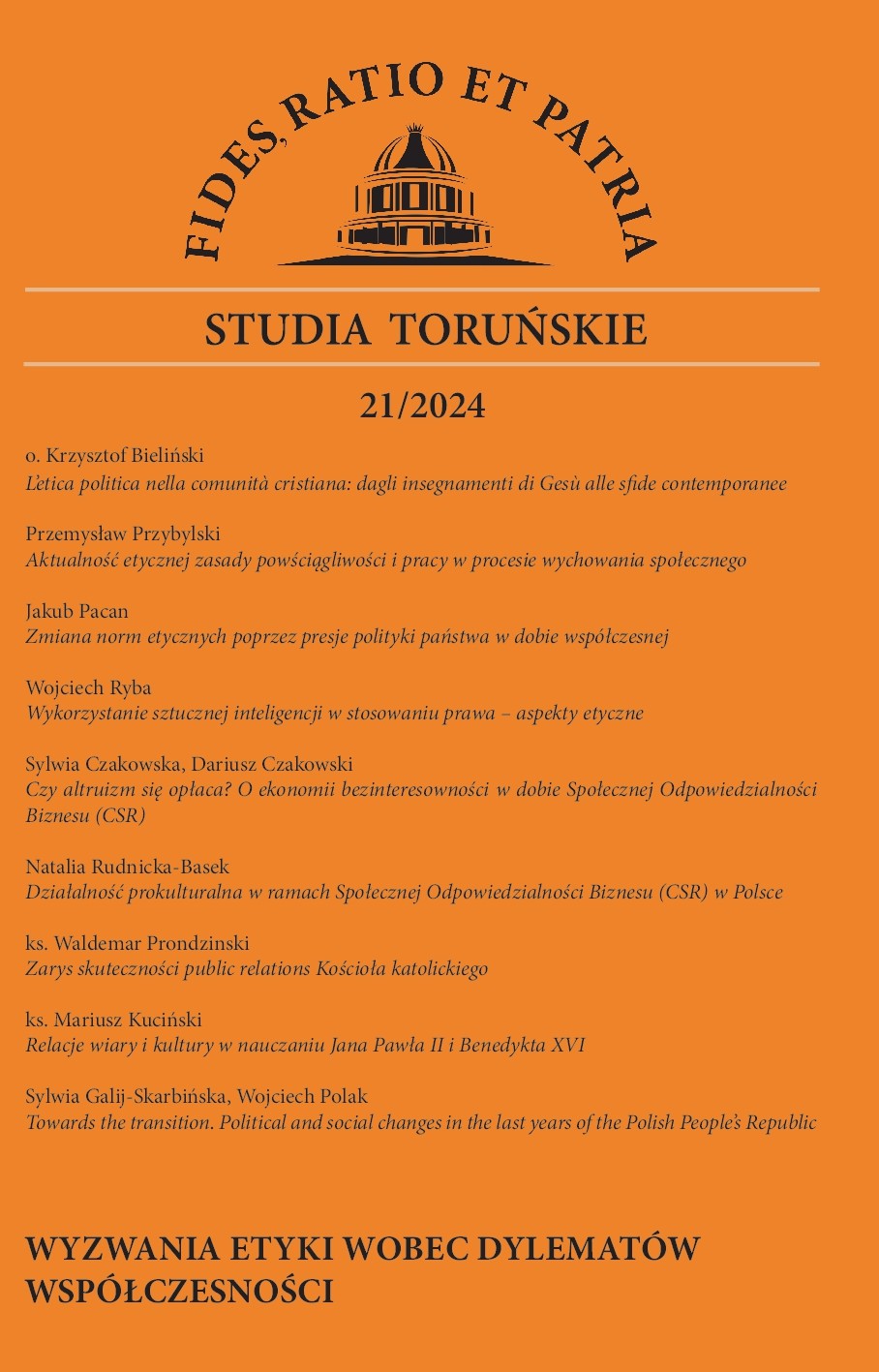
No. 21 (2024)
WYZWANIA ETYKI WOBEC DYLEMATÓW WSPÓŁCZESNOŚCI
The ethical challenges posed by contemporary dilemmas stem from rapid technological, social and cultural changes. The development of artificial intelligence, genetic engineering and biotechnology raises questions about the limits of human interference in nature and responsibility for the consequences of such actions. Globalisation and crises – climate, migration and economic – require new models of solidarity and justice that go beyond the interests of individuals or nation states. Ethics must therefore address the tension between progress and the protection of fundamental values such as dignity, freedom and equality. In this context, it is crucial to seek universal principles that will allow us to navigate a world of increasingly complex moral choices. Ultimately, ethics becomes not only a field of philosophical reflection, but also a practical compass for politics, law and the everyday decisions of individuals. Its task is to show how to preserve humanity in a world where the pace of change often outstrips our ability to assess it morally. Christian ethics begins with a simple fact: every person has inviolable dignity because they are not a thing or a resource, but a person. Human life is a fundamental good from conception to natural death. The end does not justify the means. Love of neighbour, truth and justice are not slogans, but criteria for decision-making. We look at artificial intelligence, biotechnology, climate, migration, economics and politics from this perspective. Technology should serve the person, not the other way around. Algorithms cannot objectify human beings or hide the mechanics of decisions that affect health, work or freedom. Those who use AI in high-risk areas take responsibility: they must ensure explainability, the possibility of appeal and the presence of humans in key decisions. Manipulation of attention, profiling without real consent and systems of ‘social assessment’ of people are contrary to human dignity. In bioethics, the line is clear: we treat people, we do not ‘design’ them. Repair therapies with proportionate risk and informed consent make sense; germline editing for ‘improvements’ or experiments that destroy embryos do not pass the moral test. If the risk affects the most vulnerable, the precautionary principle and the principle of double effect apply: good intentions are not enough, the means must also be morally acceptable and proportionate.